Fresh Acorn Fruit Line Art
A Quiet, Confident Statement—Not a Loud Decoration
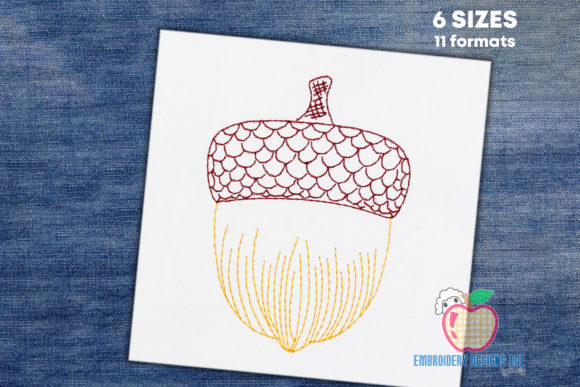
When I first opened the Fresh Acorn Fruit Line Art embroidery file, I didn’t reach for my hoop right away—I paused. There’s something rare in machine embroidery design: restraint that still carries weight. This isn’t a busy botanical motif or an over-rendered food illustration. It’s clean, grounded, and quietly intentional—a single acorn drawn with confident line work, minimal curves, and just enough detail to read as fresh, natural, and hand-drawn. It lands somewhere between rustic charm and modern minimalism, which makes it unusually versatile for real-world projects.
Where It Naturally Belongs (and Where It Surprises)
I recently used Fresh Acorn Fruit Line Art on a set of linen tea towels for a small-batch kitchen boutique launch. No embellishment—just the design centered near the hem in soft olive thread. Customers kept picking them up, turning them over, commenting on how “calm” and “thoughtful” the motif felt—not flashy, but memorable. That’s the sweet spot: handmade products where authenticity matters more than volume.
It also worked beautifully on a lightweight cotton apron for a local coffee roaster’s staff gift—stitched in muted terracotta on oat-colored fabric. The line art translated cleanly, with no fill stitch bulk, and held up after three test washes without fraying or distortion. As a machine embroidery design, its low stitch density means it’s forgiving on medium-weight woven fabrics like quilting cotton, linen blends, and stable twills—ideal for tote bag designs, pillow covers, and baby embroidery on onesies or burp cloths.
What surprised me was how well it scaled down. At 2.8 inches wide, it stayed legible on a child’s sweatshirt cuff—and at 4.2 inches, it anchored a large canvas tote without overwhelming the space. That adaptability is gold for Etsy sellers juggling multiple product types: one digital embroidery file, many finished product applications.
Where to Proceed With Care
This isn’t a design that hides flaws. Its simplicity means every stitch decision shows. On stretchy fabric—like jersey t-shirts or ribbed knit caps—the outline can waver if stabilizer isn’t layered thoughtfully. I recommend cutaway + tear-away combo for anything with give, especially for sweatshirt embroidery or custom apparel meant for daily wear.
Dark fabric demands attention too. Because Fresh Acorn Fruit Line Art relies on contour clarity rather than dense fills, thread color contrast becomes critical. A light tan thread on navy denim? Gorgeous—if tested first. But a pale ecru on charcoal? It’ll vanish unless you add a subtle underlay or switch to a slightly heavier weight thread.
Curved surfaces—like baseball caps or curved pillow edges—require repositioning the design so the acorn’s base sits flat against the seam or curve. I’ve seen it tilt awkwardly on poorly hooped caps, breaking the organic feel. And while it’s not an applique design, avoid pairing it with heavy decorative accents nearby; its quiet strength gets lost next to dense satin stitch florals or dense fill-stitch borders.
Real Impact on Customer Perception
As a designer who ships embroidered holiday gifts and personalized gifts year-round, I notice how motifs shape buyer trust. Fresh Acorn Fruit Line Art reads as intentional, not algorithm-generated. That builds credibility—especially for craft business owners positioning themselves as thoughtful makers, not mass resellers. When customers see this on a nursery decor pillow or a wedding favor tea towel, they don’t think “generic food embroidery.” They think “someone chose this because it means something.”
That meaning translates into perceived value. A $28 linen pillow with this design sells faster—and at full price—than one with a busier, less resolved fruit motif. It feels curated, not cluttered. For small shop product listings, it photographs cleanly in natural light, works in black-and-white mockups, and holds up in thumbnail previews—critical for Etsy visibility and social media scrolling.
Practical Designer Notes You’ll Actually Use
- Always test on scrap fabric first—especially if stitching on textured weaves or blends. Linen’s slubs can catch fine lines; a quick run confirms whether your needle tension needs adjustment.
- Check thread color contrast early. Try your top thread against both light and dark fabric swatches before hooping. A neutral tone like warm grey or moss green often bridges both better than stark white or black.
- Review stitch density in your embroidery software. If the file includes optional underlay or pull compensation, enable it for knits or loosely woven fabrics.
- Confirm hoop size compatibility. This design fits comfortably in a 4x4 hoop—but verify your machine’s exact usable area, since some models lose 0.1–0.2 inches at the edges.
- Inspect small details at 200% zoom: the cap’s subtle curve, the acorn’s stem taper, and the gentle break in the shell line. These are what make it feel hand-drawn—not mechanical.
- Test in monochrome mockups before finalizing product photos. If it reads clearly in grayscale, it’ll hold up across print catalogs, packaging, and digital ads.
- Use proper stabilizer—no shortcuts. Even on stable cotton, a light tear-away prevents puckering in the stem and tip areas.
- Verify licensing terms before selling finished items or bundling the embroidery file with other design assets. Commercial use permissions vary widely—even for seemingly simple line art.
Final Thought: It’s Not Just an Acorn—It’s a Design Decision
Choosing Fresh Acorn Fruit Line Art isn’t about filling space—it’s about signaling care. In a market saturated with loud, trend-driven motifs, this design earns attention by breathing room, balance, and botanical sincerity. It suits food-adjacent branding (think farm stands, artisanal preserves, herbal teas) without shouting “fruit.” It fits nursery decor without being cutesy. It elevates kitchen textiles without competing with the food itself.
If you’re selecting embroidery project assets for long-term brand consistency—or building a cohesive collection of printable mockups, holiday embroidery kits, or small shop merchandise—this is the kind of embroidery design that compounds value over time. It doesn’t date quickly. It doesn’t demand constant reinvention. It simply belongs—quietly, confidently, and exactly where it’s needed.